The 3 Levels of SEO Strategy: From Beginner Hustle to Advanced Ecosystem
Stuck in the endless chase for backlinks? This guide is the perfect SEO for beginners and pros alike. Discover the 3 levels of a successful SEO strategy, moving from basic tactics to an advanced SEO content ecosystem. Learn how to build a system that attracts traffic, not just chases it.
This guide was refreshed on March 31, 2026 to keep the advice aligned with the current creator-platform, SEO, and monetization landscape.
- Added clearer framing around how to diagnose your current SEO level.
- Refreshed the article so it connects more explicitly to topic clusters and owned media systems.
- Updated the guide to better align with current creator SEO and GEO workflows.
TL;DR
- Level 1 SEO is mostly about acquiring links and visibility outside your site, which is useful but hard to scale on its own.
- Level 2 shifts the work inward by improving internal links, structure, and user journeys so your site becomes easier to navigate and rank.
- Level 3 turns your site into an ecosystem built around pillars, clusters, and assets that attract links because they are worth citing.
- The real upgrade is not tactical complexity but moving from isolated SEO tasks to a compounding content system on owned properties.
Best for
- Creators and indie founders who are stuck in one-off SEO tactics and want a more strategic model.
- Marketers rebuilding a blog around internal links, pillar content, and topic authority.
- Readers who want to understand how beginner, intermediate, and advanced SEO fit together.

For creators and indie developers, the directive to "do SEO" frequently translates into a demanding and often inefficient pursuit of backlinks. This initial approach, while foundational, represents a common bottleneck in digital growth strategies.
This initial phase is defined as Level 1 SEO. While it serves as a necessary entry point, it is also where many individuals encounter limitations in scalability and sustained impact.
Achieving true, sustainable digital growth necessitates a shift from external link acquisition to the development of a robust, interconnected content system on owned properties. This strategic evolution from an SEO tactical operator to an SEO strategist defines a successful SEO career path and addresses the critical question: what are the levels of SEO?
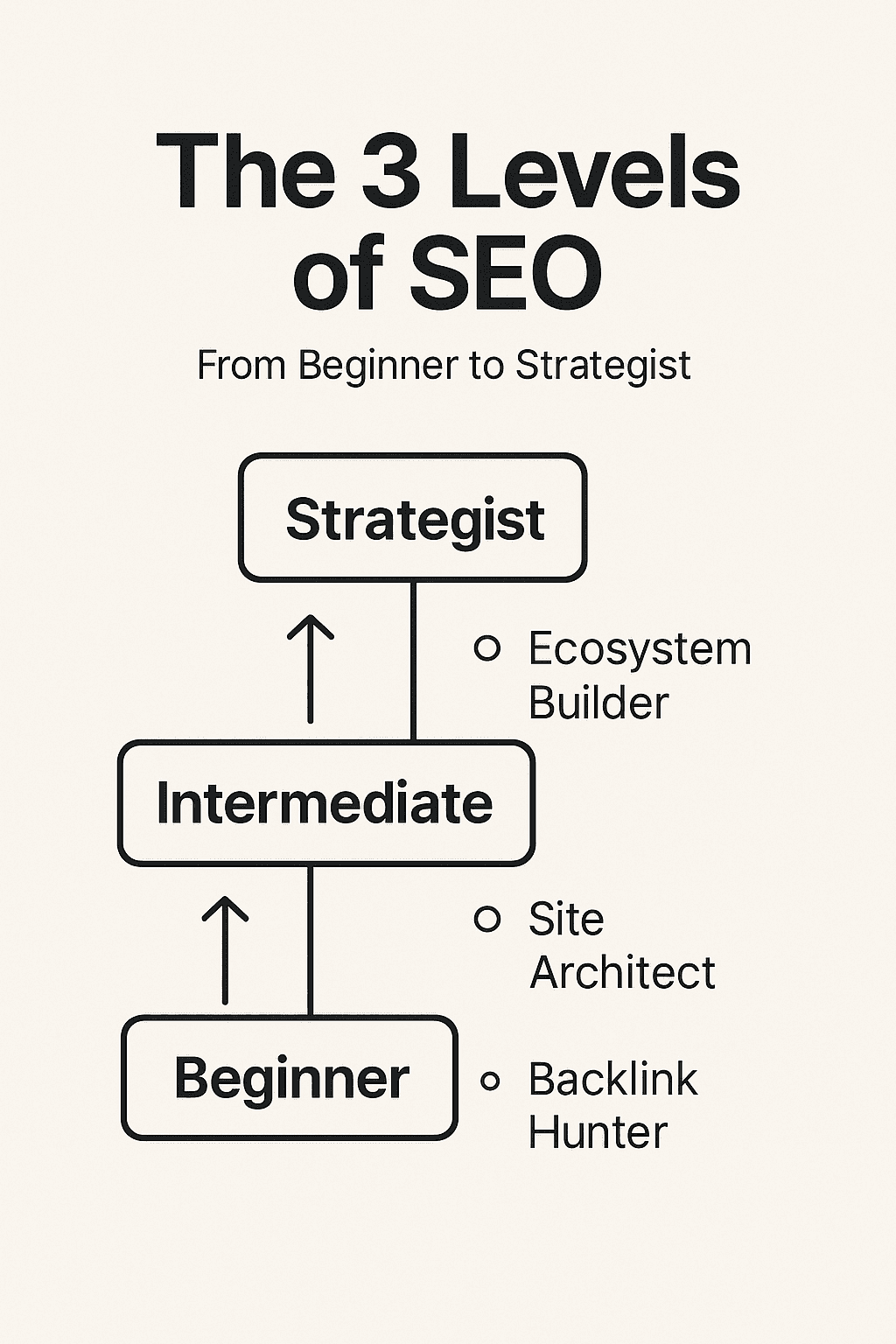
Level 1: The Backlink Hunter (SEO for Beginners)
This level represents the initial and most prevalent approach to search engine optimization. The primary focus at this stage is off-page SEO, which encompasses all activities conducted outside of one's own website to influence search engine rankings. It is the fundamental starting point for individuals initiating their SEO for beginners journey.
Typical activities at Level 1 include:
- Identifying and engaging with high Domain Authority (DA) or Domain Rating (DR) platforms for backlink acquisition.
- Crafting and submitting guest posts to relevant blogs within a specific niche.
- Establishing profiles on social media platforms and industry-specific directories.
- Engaging in direct outreach efforts to secure external endorsements and visibility.
Importance: This foundational effort is crucial for establishing a website's initial authority and signaling to search engines like Google that the site exists and is recognized by other online entities. It serves as the initial validation step for online presence.
Limitations: This approach is characterized by significant time investment, often consuming up to 70% of initial SEO efforts, and exhibits limited scalability. Growth is directly correlated with continuous outreach, making it a strong foundation but an unsustainable long-term SEO strategy ceiling.
Level 2: The Site Architect (The Intermediate Breakthrough)
This stage marks a strategic pivot from external link acquisition to internal site optimization. The focus shifts from external validation to the systematic structuring of one's own digital property. This is where a comprehensive SEO strategy begins to materialize.
The core competency at Level 2 is the mastery of on-page SEO, with particular emphasis on Internal Linking.
An internal link is defined as a hyperlink connecting one page on a website to another page on the same website. While seemingly straightforward, its strategic implementation yields profound benefits. A smart internal linking strategy for blogs is demonstrably transformative for overall site performance.
Key benefits include:
- Authority Distribution: High-performing content assets (e.g., popular articles) function as authoritative hubs. By linking from these strong pages to other, less visible posts, a portion of their accumulated ranking power, often referred to as "link equity," is transferred. This process elevates the collective ranking potential of the entire site, akin to a rising tide.
- Enhanced User Experience and Navigation: Internal links guide visitors through a logical content journey. This structured navigation significantly increases metrics such as session duration and pages-per-visit, which are critical indicators of content quality and user engagement for search engines.
- Improved Search Engine Crawlability and Understanding: A meticulously internally linked site provides a clear structural map for search engine crawlers. This organization facilitates efficient indexing, clarifies content relationships, and reinforces the site's topical authority around specific topic clusters.
At this level, the objective transitions from merely accumulating external links to constructing a robust, interconnected content infrastructure.
Level 3: The Ecosystem Builder (The Advanced SEO Strategist)
At the pinnacle of SEO strategy, the perspective expands beyond individual pages and links to encompass the entire content ecosystem. This represents the essence of advanced SEO, where the strategic design of the content landscape takes precedence over tactical execution.
The fundamental inquiry evolves from "How can I acquire a link?" to "How can I create content so inherently valuable that others naturally desire to link to it?"
This advanced stage centers on the development of link magnets. The strategic focus includes:
- Pillar Content and Topic Clusters: This involves creating comprehensive, authoritative "pillar" guides on broad subjects (e.g., "The Definitive Guide to Indie Game Marketing"). These pillars are then supported by a network of smaller, specialized "cluster" posts that delve into specific sub-topics (e.g., "Developing a Press Kit," "Leveraging TikTok for Game Promotion," "Strategies for Discord Community Building"). All cluster content strategically links back to the main pillar, establishing profound topic authority and demonstrating how to create an SEO strategy for sustained relevance.
- Digital Assets: The creation of freely accessible, high-value digital resources is a cornerstone. Examples include interactive calculators, comprehensive checklists, data-rich industry reports, or proprietary online tools. These assets inherently attract backlinks due to their utility and informational value.
- Mastering Search Intent: A deep analytical understanding of the underlying purpose behind a search query is paramount. For a long-tail keyword such as "how to price a SaaS product," the strategist analyzes user anxieties, specific questions, and desired outcomes. The objective is then to produce the most comprehensive and authoritative resource available online that precisely satisfies that identified intent.
At this advanced stage, a self-sustaining system is established that consistently attracts organic traffic and builds domain authority with minimal ongoing manual intervention. This signifies the transition to a true digital publisher model.
How to Tell Which SEO Level You Are Actually In
You are probably still at Level 1 if most of your effort goes into outreach, backlinks, and posting on third-party sites without a strong internal content structure.
You are moving into Level 2 if you are actively restructuring archives, tightening internal links, and thinking about how posts support each other instead of publishing as isolated pages.
You are entering Level 3 when your content is intentionally mapped into pillars, supporting clusters, reusable digital assets, and long-term topic authority plays that keep earning traffic after publication.
Your Journey Starts with a Single Step
The progression from Level 1 to Level 3 constitutes the definitive roadmap for a successful SEO career path. This journey fundamentally begins with establishing a proprietary platform for content—a digital property that is owned and fully controlled.
While backlink acquisition remains a component of SEO, the construction of an interconnected library of high-value content is the primary driver of lasting success. This content requires a fast, reliable, and aesthetically optimized hosting environment.
At Postion, our platform is specifically engineered to support creators through this strategic evolution. It provides a streamlined, SEO-friendly infrastructure, enabling a focus on content ecosystem development rather than technical complexities.
Ready to build your own robust content infrastructure? Learn more about how Postion helps creators build and own their audience.
FAQ
Q1: What are the three levels of SEO strategy? A1: The three levels of SEO strategy are: Level 1, The Backlink Hunter (focused on off-page SEO and external link acquisition); Level 2, The Site Architect (focused on on-page SEO and internal linking to build site structure); and Level 3, The Ecosystem Builder (focused on creating valuable content ecosystems and link magnets to attract organic authority).
Q2: How does internal linking improve a website's SEO? A2: Internal linking significantly improves SEO by distributing link equity (authority) across a site, enhancing user navigation and engagement (increasing session duration and pages-per-visit), and helping search engine crawlers better understand the site's structure and topical relevance, leading to improved indexing and rankings.
Q3: What is a "link magnet" in advanced SEO? A3: A "link magnet" is a piece of content or a digital asset designed to naturally attract backlinks from other websites due to its exceptional value, utility, or comprehensiveness. Examples include pillar content, data-rich reports, free tools, or definitive guides that serve as authoritative resources in a niche.
Topic Hub
Explore the SEO & GEO Hub
This article is part of a larger cluster. Use the hub page to move between the pillar guide and the supporting articles that reinforce the same topic.
Keep Exploring
Related Reads
More posts connected to this topic cluster and reading path.
Internal Linking for SEO: Your On-Page Superpower
Unlock powerful SEO growth by mastering internal linking. Learn how to create an internal linking strategy for your blog, build topic clusters, and distribute authority for higher rankings.
Blog SEO Secrets: We Analyzed 100 Top Creator Blogs. Here's What Works.
Curious about the SEO secrets that drive massive organic traffic? We analyzed 100 top creator blogs to decode their content strategy. Learn the SEO best practices they use for long-term growth.
What is the Best Ecommerce Platform for SEO in 2026?
What's the best ecommerce platform for SEO? We compare Shopify, BigCommerce, and WooCommerce on their ecommerce SEO features, and reveal why a content-led strategy is the key to winning.