Beyond the Blog Post: How a Knowledge Hub Maximizes Your Content Strategy
Your best content gets buried in a chronological feed. Learn how to transform your blog into a structured 'Knowledge Hub' using topic clusters to boost user engagement, authority, and SEO.

You wrote a phenomenal, evergreen guide three months ago. Today, it’s buried on page 7 of your blog, lost under a pile of more recent posts. Sound familiar?
This is the fundamental flaw of the traditional blog format: it's a reverse-chronological feed that actively devalues your best content. The problem is a lack of effective content organization. Your site becomes a content graveyard where valuable assets go to die.
It's time to upgrade your content strategy. It's time to build a Knowledge Hub.
What is a Knowledge Hub?
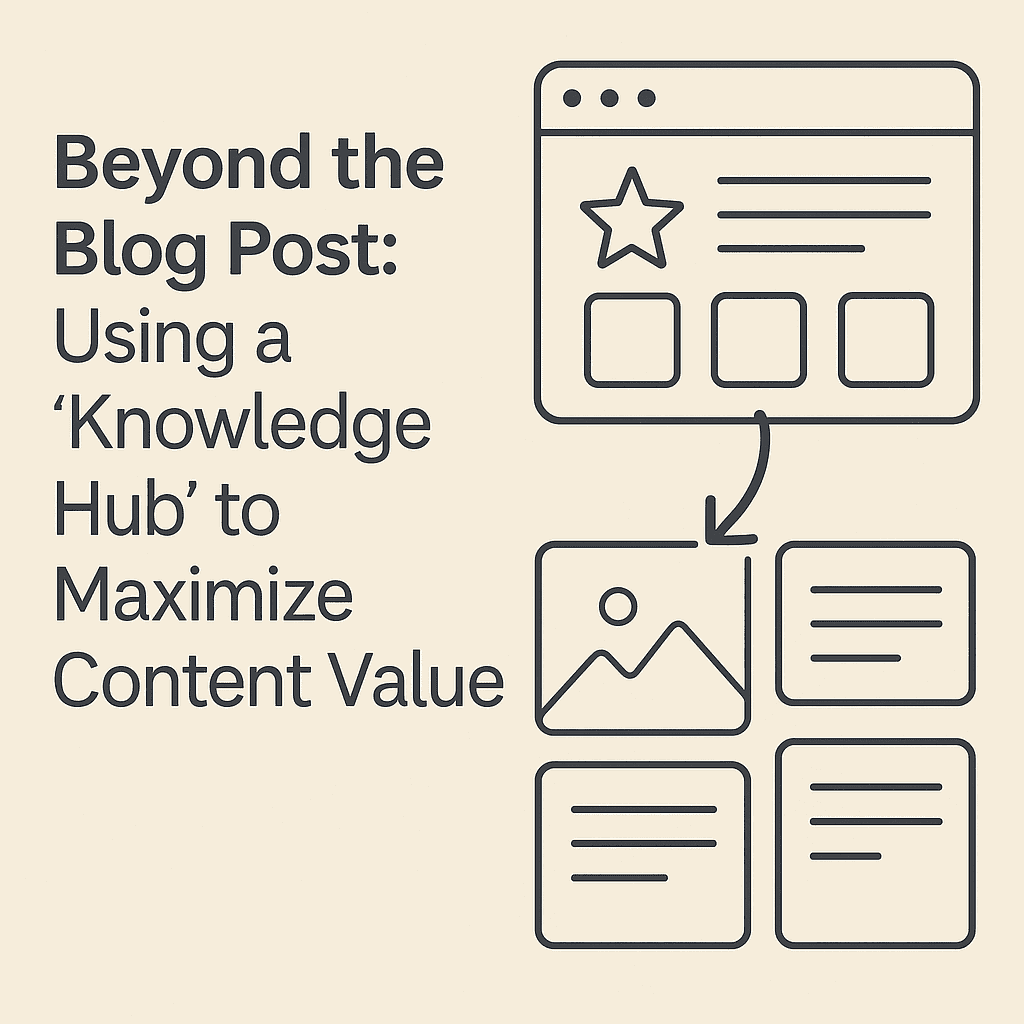
A Knowledge Hub is a model for organizing your content based on topic and relevance, not just publication date. It transforms your website from a linear stream of posts into a structured, interconnected library. This structure is the practical application of the powerful Topic Cluster and Pillar Content models.
Think of it as your personal Wikipedia. When a reader finishes one article, they are intelligently guided to the next logical piece of content, dramatically increasing user engagement and session time.
The 4 Key Benefits of a Knowledge Hub Model
- Increases Perceived Value: A well-organized library feels more premium and authoritative than a messy blog feed.
- Boosts User Engagement: By linking related articles together into series or collections, you encourage "binge-reading," keeping visitors on your site longer. This is a powerful positive signal to Google.
- Enhances SEO Authority: This structure is the physical implementation of the "Topic Cluster" model. You create a main "Pillar" page for a broad topic and surround it with "Cluster" pages on sub-topics, all interlinked. This clearly demonstrates your expertise and helps increase SEO authority.
- Future-Proofs Your Content: Your Knowledge Hub becomes the foundation of your evergreen content strategy. You can easily update or add to a series over time, keeping it relevant for years.
How to Build Your Knowledge Hub on Postion
We designed Postion's architecture specifically for this content strategy. You don't need complex plugins to figure out how to organize your blog content.
- Use "Series": Group related articles together. When a reader finishes Part 1 of your "Growth Hacking" series, a link to Part 2 is automatically displayed. This is a perfect way to build out your Pillar Content and its clusters.
- Use "Tags" for Cross-Pollination: Tag your articles with relevant keywords (e.g., #SaaS, #Marketing, #SEO). This allows readers to explore all your content on a specific topic.
- Create Custom "Pillar Pages": Build dedicated landing pages that act as a table of contents for your most important Topic Clusters, linking out to all the relevant articles and series.
Stop letting your hard work get lost in the archives. Start building a Knowledge Hub and transform your content into a lasting asset that serves both you and your readers.
A well-structured Knowledge Hub is a cornerstone of any serious content strategy. Learn how it fits into the complete Creator's Playbook.
Topic Hub
Explore the SEO & GEO Hub
This article is part of a larger cluster. Use the hub page to move between the pillar guide and the supporting articles that reinforce the same topic.
Keep Exploring
Related Reads
More posts connected to this topic cluster and reading path.
The 3 Levels of SEO Strategy: From Beginner Hustle to Advanced Ecosystem
Stuck in the endless chase for backlinks? This guide is the perfect SEO for beginners and pros alike. Discover the 3 levels of a successful SEO strategy, moving from basic tactics to an advanced SEO content ecosystem. Learn how to build a system that attracts traffic, not just chases it.
Internal Linking for SEO: Your On-Page Superpower
Unlock powerful SEO growth by mastering internal linking. Learn how to create an internal linking strategy for your blog, build topic clusters, and distribute authority for higher rankings.
What is the Best Ecommerce Platform for SEO in 2026?
What's the best ecommerce platform for SEO? We compare Shopify, BigCommerce, and WooCommerce on their ecommerce SEO features, and reveal why a content-led strategy is the key to winning.